

E-commerce logistics is built around order volume, order frequency and delivery speed. Compared with a traditional warehouse, an e-commerce fulfillment operation may process a large number of small orders within a short period. Goods move repeatedly between receiving, storage, picking, sorting, packing, staging and dispatch.
This creates a different requirement for material-handling equipment.
A trolley that is suitable for occasional warehouse movement may not perform well when it is pushed hundreds of times through narrow aisles every day. A cage that works for temporary storage may not be suitable for parcel sorting. Equipment dimensions also need to match packing stations, conveyor interfaces, loading docks and delivery vehicles.
From SUVA's perspective, e-commerce logistics equipment should be planned around the order-flow process, not simply around the warehouse.


A typical operation follows:
Inbound Receiving → Putaway → Picking → Order Consolidation → Sorting → Packing → Dispatch → Last-Mile Delivery
For retail groups operating both online and offline channels, the flow can be more complex:
Supplier → Warehouse → E-commerce Order → Fulfillment → Delivery
and:
Supplier → Distribution Center → Retail Store
The equipment fleet must support both flows when inventory is shared.
01. Application Overview

An e-commerce logistics facility handles more than storage.
The warehouse may receive products in bulk but ship them as individual orders. This creates a significant change in material flow.
Traditional Wholesale Flow
Supplier → Warehouse → Pallet / Bulk Shipment → Customer
E-commerce Flow
Supplier → Warehouse → Storage → Picking → Sorting → Packing → Parcel → Delivery
The number of handling operations increases significantly.
Typical E-commerce Applications
SUVA equipment can support:
- Fulfillment centers
- E-commerce warehouses
- Retail online-order warehouses
- Omnichannel fulfillment facilities
- Regional distribution centers
- Return processing centers
- Store-based fulfillment facilities
- Click-and-collect operations

The equipment is mainly used for:
Picking
Moving products from storage to order consolidation.
01
Sorting
Separating orders by customer, delivery route or carrier.
02
Staging
Holding completed orders before dispatch.
03
Returns
Separating returned products for inspection and processing.
04
Retail Replenishment
Moving inventory from the same warehouse to physical stores.
05
This last application is particularly relevant for retailers operating both e-commerce and brick-and-mortar channels.
02. Operational Requirements
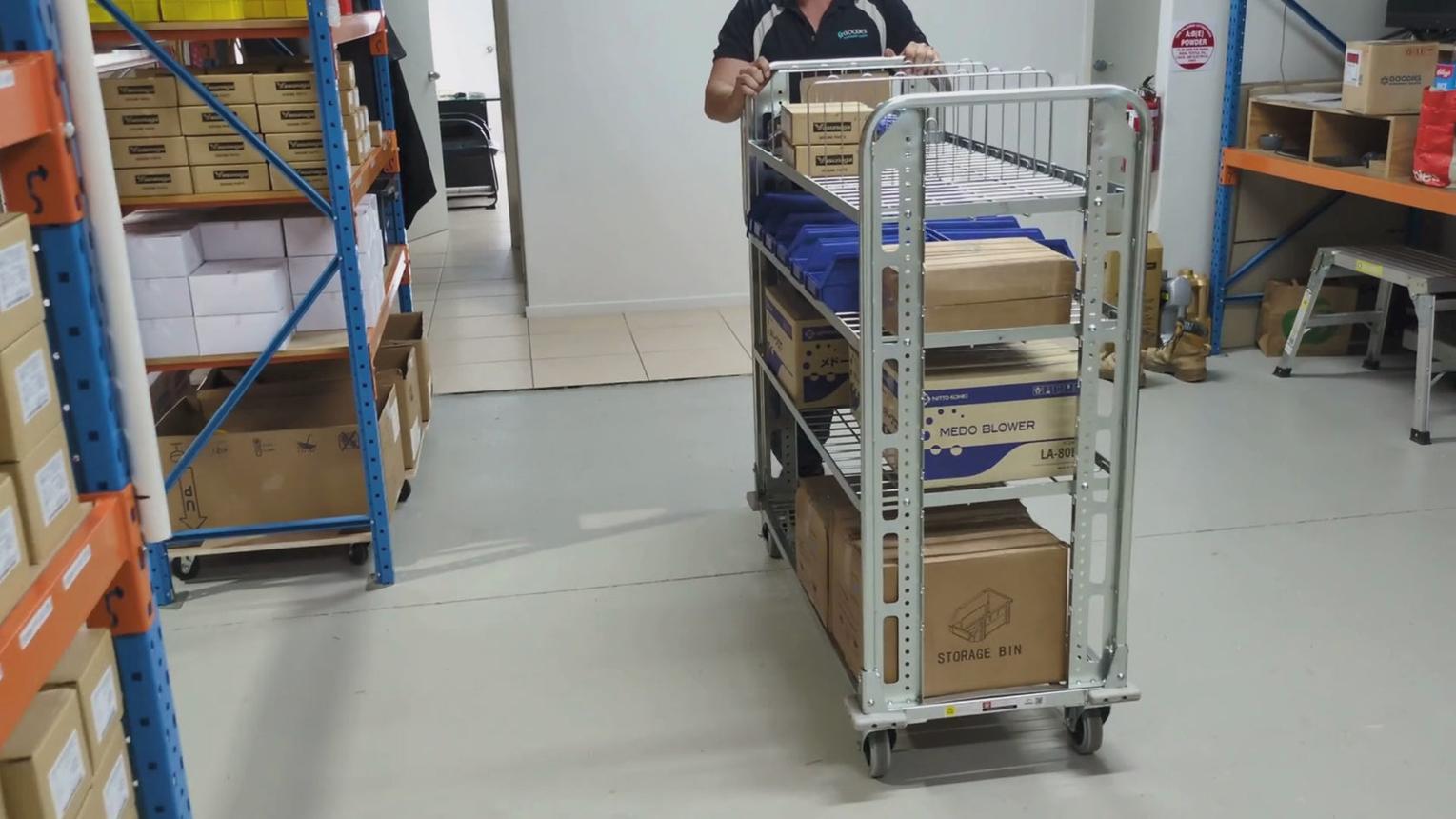
High Order Frequency
An e-commerce warehouse may handle thousands of individual orders within a day.
The equipment therefore experiences:
- Frequent loading
- Frequent pushing
- Repeated turning
- Repeated unloading
- Continuous movement
The frame and wheel assembly need to withstand this operating pattern.
Small-Order Picking
Unlike pallet-based distribution, e-commerce picking often involves small quantities.
A single trolley may contain:
- Several customer orders
- Different SKUs
- Small cartons
- Polybags
- Accessories
- Fragile items
The trolley should help operators separate these orders without unnecessary sorting later.
Fast Order Consolidation
After picking, products may need to be grouped according to:
- Order number
- Customer
- Delivery route
- Carrier
- Service level
A cage or trolley with multiple compartments can support this process.


Peak-Period Demand
E-commerce logistics often experiences significant peaks during:
- Black Friday
- Christmas
- New Year
- Seasonal promotions
- Online shopping festivals
- Flash sales
Equipment planning should account for these periods rather than using average daily volume alone.
Returns
E-commerce returns can represent a substantial reverse-logistics workload.
The warehouse may need separate equipment for:
Returned → Inspection → Approved → Restock
and:
Returned → Damaged → Repair / Disposal
Keeping these flows separate reduces unnecessary product movement.
03. Equipment Requirements
E-commerce logistics equipment should be evaluated against five basic conditions:
Volume
How many orders or parcels are processed?
Load
How much weight does each unit carry?
Frequency
How many operating cycles does the equipment complete?
Space
How narrow are the aisles and workstations?
Destination
Will the equipment remain inside the warehouse or travel to stores and delivery points?


Roll Containers
Roll containers are suitable for:
Order staging
Picking
Parcel movement
Store replenishment
Returns
Dispatch preparation
Storage Cages
Storage cages are useful for:
Returns
Temporary stock
Oversized products
Store-specific orders
Promotional inventory
Trolley Configuration
Depending on the application, the equipment may require:
- Multiple shelves
- Compartments
- Mesh sides
- Doors
- Identification panels
- Brakes
- Different caster configurations
The equipment should be specified after the warehouse workflow has been mapped.

04. Recommended Products

1. Roll Container for Order Staging
A roll container can hold completed orders after picking and before packing or dispatch.
It is particularly useful when orders are consolidated by:
Carrier
Route
Store
Delivery time
2. Storage Cage for Returns
Returns can be separated by processing status.
For example:
Return Inspection
Quality Approved
Damaged
Pending Processing
A dedicated cage for each category can reduce mixing and repeated handling.


3. Logistics Cage for Store Replenishment
For omnichannel retailers, the same equipment can move products from the fulfillment center to physical stores.
This creates a shared equipment flow:
E-commerce Warehouse → Store
and:
Distribution Center → Store
4. Shopping Cart
Where e-commerce and physical retail operations share inventory, shopping carts may be included in a broader retail-equipment procurement program.
05. Equipment Selection
E-commerce equipment selection should begin with order data.
Order Profile
Determine:
- Average order weight
- Maximum order weight
- Average SKU count
- Average units per order
- Product dimensions
- Carton dimensions
Picking Method
Different picking methods require different equipment.
Single-Order Picking
One trolley is assigned to one customer order.
Suitable when:
- Orders are large
- Product mix is complex
- Order volume is moderate


Batch Picking
One trolley carries several orders.
Suitable when:
- Many orders contain small quantities
- Products are relatively small
- Picking efficiency is important
Zone Picking
Different warehouse zones handle different product categories.
Equipment must be easy to move between zones.
Sorting Requirement
If a trolley carries multiple orders, compartments or identification areas can reduce sorting errors.
Wheel Selection
For high-frequency e-commerce picking, wheel quality becomes particularly important.
The selection should consider:
- Push force
- Turning radius
- Noise
- Floor condition
- Load
- Operating hours
06. Store / Facility Layout
Receiving Area
Inbound goods should be unloaded and inspected before entering storage.
Roll containers and cages can be used for temporary staging.
Picking Area
The trolley should fit the actual aisle.
If aisles are narrow, excessive trolley width creates:
- Difficult turning
- Reduced pedestrian clearance
- Lower picking efficiency
Sorting Area
Orders can be separated by:
- Carrier
- Route
- Region
- Delivery service
- Store
Cages are particularly useful for temporary order grouping.


A typical e-commerce facility can be divided into:
Receiving
↓
Putaway
↓
Storage
↓
Picking
↓
Sorting
↓
Packing
↓
Outbound Staging
↓
Loading
↓
Carrier Collection
Packing Area
Equipment should not obstruct:
- Packing benches
- Conveyor lines
- Walking routes
Outbound Area
Completed orders should move directly from packing to dispatch staging.
Equipment should be organized according to the carrier or route.

07. Capacity Planning

The required number of trolleys and cages should be calculated from actual operating volume.
Basic Fleet Calculation
Daily Orders
- Orders per Equipment Unit
- Equipment Turnaround Cycles
- Peak Reserve
- Required Equipment Quantity
For example, if one trolley carries 20 small orders per picking cycle, the warehouse processes 2,000 orders per day, and each trolley can complete 5 effective cycles:
2,000 ÷ 20 ÷ 5 = 20 trolleys
This is only a planning example. Actual fleet size should also include:
- Cleaning
- Maintenance
- Waiting time
- Sorting
- Packing
- Dispatch
- Peak volume
Peak Capacity
A warehouse operating at 100% equipment utilization has little room for disruption.
A reserve fleet should be considered for:
- Promotional periods
- New product launches
- Seasonal peaks
- Unexpected order increases
- Equipment maintenance
Returns Capacity
Returns should be planned separately from outbound order volume.
The number of return cages depends on:
Return Rate × Daily Orders × Processing Time

08. Material & Technical Requirements

E-commerce equipment experiences high-frequency use, making construction details important.
Steel Frame
Important parameters include:
- Steel grade
- Tube thickness
- Tube diameter
- Wire diameter
- Reinforcement
- Welding points
SUVA identifies Q235 steel among the frame materials used in its shopping-cart products. SUVA Product Manufacturing Information
For e-commerce logistics equipment, material selection should be based on actual load and cycle requirements.
Surface Treatment
Warehouse environments may expose equipment to:
- Dust
- Moisture
- Cleaning chemicals
- Scratches
- Repeated contact
SUVA uses galvanizing and powder coating as part of its retail-equipment manufacturing processes. SUVA Manufacturing Information
Wheel Requirements
Caster specifications should cover:
- Diameter
- Material
- Bearing
- Load
- Swivel
- Fixed
- Brake
For high-frequency order picking, wheel rolling resistance should be considered together with maximum load.
Identification
E-commerce logistics benefits from clear identification.
Possible solutions include:
- Barcode plates
- Number plates
- Store codes
- Route labels
- Color identification
- QR-code mounting areas
The identification method should be compatible with the warehouse's existing WMS process.

09. Customization

An e-commerce warehouse may have existing equipment dimensions, conveyor systems and packing stations. Standard products do not always fit the facility.
SUVA supports OEM/ODM customization for retail equipment. SUVA OEM/ODM Services
Possible Customization
Dimensions
Adapt the trolley or cage to aisle and workstation dimensions.
Shelves
Useful for multi-level picking.
Compartments
Useful for batch picking.
Doors
Useful for controlled loading and unloading.
Wheels
Selected according to floor and load.
Color
Can be used for operational identification.
Logo
For brand identification.
Number Plate
For fleet management.
Nesting
For compact storage and return transport.
Multi-Channel Retail
For retailers operating:
Online Store + Physical Stores + Distribution Center
SUVA can develop a standardized equipment specification that works across the different operating environments where appropriate.
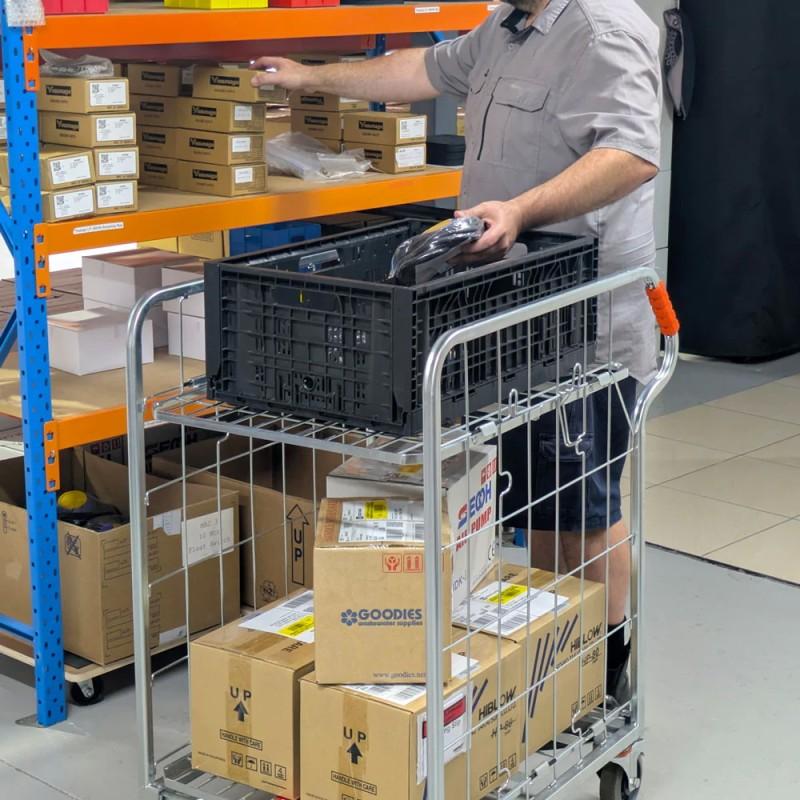
10. Manufacturing

E-commerce logistics equipment is normally purchased in batches, so dimensional consistency and repeatability are important.
SUVA's published factory information lists:
- 30,000 m² manufacturing facility
- 300+ skilled workers
- 30+ automated production lines
- 150,000 roll containers annual capacity
- 150,000 storage cages annual capacity
- 300,000 shopping carts annual capacity SUVA Factory Capacity
Production Process
Raw Material
↓
Cutting
↓
Bending
↓
Welding
↓
Grinding
↓
Surface Treatment
↓
Assembly
↓
Wheel Installation
↓
Inspection
↓
Packaging


For an OEM e-commerce logistics project, the approved sample should become the production reference.
The manufacturing documents should clearly define:
- Product drawing
- Material
- Dimensions
- Load rating
- Wheel
- Surface treatment
- Packaging
- Inspection requirements
11. Quality Control
In e-commerce operations, equipment failure can interrupt picking or dispatch. Quality inspection therefore needs to cover both structure and mobility.
Raw Material Inspection
Check:
- Steel grade
- Thickness
- Dimensions
- Surface condition
Welding Inspection
Check:
- Joint position
- Welding consistency
- Structural strength
- Sharp edges


Dimension Inspection
Check:
- Overall dimensions
- Shelf position
- Mesh
- Door
- Wheel location
Load Testing
Check:
- Static load
- Stability
- Deformation
- Wheel performance
Mobility Testing
Check:
- Straight movement
- Turning
- Steering
- Wheel rotation
- Brake function
Surface Treatment
Check:
- Coating coverage
- Adhesion
- Surface finish
- Corrosion resistance
SUVA states that its quality system covers raw materials, semi-finished products and finished products, with testing capabilities including salt-spray, tensile, hardness and temperature-related testing. SUVA Quality Control Information
For high-volume e-commerce projects, the inspection standard should be agreed before mass production.

12. Project Case

E-commerce Fulfillment Equipment Standardization
A retail company operates an e-commerce warehouse serving customers across several regions.
The warehouse has grown rapidly, and the original equipment fleet contains several trolley models.
The operating team identifies several problems:
- Different trolley sizes
- Inconsistent wheels
- Limited order separation
- Difficult empty-trolley storage
- Different replacement parts
- Insufficient equipment during promotional periods
The company decides to establish a standardized equipment system.
Step 1 - Analyze Order Characteristics
The warehouse provides:
- Average daily order volume
- Peak daily order volume
- Average order weight
- Average SKU count
- Product dimensions
- Return volume
Step 2 - Review Warehouse Layout
SUVA evaluates:
- Picking aisles
- Storage locations
- Packing stations
- Sorting area
- Loading docks
- Door widths


Step 3 - Select Equipment
A combination of:
- Roll Containers
- Storage Cages
is considered for picking, staging, returns and dispatch.
Step 4 - Develop Sample
The sample is customized according to:
- Warehouse dimensions
- Order volume
- Load
- Wheel requirements
- Identification requirements
Step 5 - Operational Testing
The warehouse team evaluates:
Pick → Sort → Stage → Pack → Dispatch
The focus is on handling efficiency and equipment movement.
Step 6 - Final Specification
The approved specification includes:
Product Drawing + BOM + Material + Dimensions + Wheel + Load Rating + Inspection Standard
Step 7 - Mass Production
SUVA produces according to the approved reference.
Step 8 - Fleet Deployment
The standardized equipment is introduced into the fulfillment operation.
For a real SUVA case-study page, verified customer data should be inserted here, including project scale, equipment quantity, application environment and measurable results. Avoid publishing invented figures simply to make the case study look complete.
13. FAQ
Q: 1. What Equipment Is Suitable For E-Commerce Logistics?
A: Roll containers, storage cages and specialized handling trolleys can be used for picking, sorting, staging, returns and dispatch.
Q: 2. Are Roll Containers Suitable For E-Commerce Warehouses?
A: Yes. They can be used for order staging, internal movement, returns and store replenishment.
Q: 3. Can One Roll Container Carry Multiple Orders?
A: Yes, when the design and internal organization are suitable for batch picking or order consolidation.
Q: 4. Can SUVA Customize Compartments Or Shelves?
A: Yes. Custom shelves, compartments and other structural configurations can be discussed according to the warehouse process.
Q: 5. How Do I Choose The Correct Trolley Dimensions?
A: Start with aisle width, turning space, door dimensions, packing-station clearance and required load volume.
Q: 6. What Wheel Is Suitable For An E-Commerce Warehouse?
A: Wheel selection depends on load, floor material, operating hours, travel distance, turning frequency and noise requirements.
Q: 7. How Many Trolleys Does An E-Commerce Warehouse Need?
A: The quantity depends on daily order volume, orders per trolley, turnaround time, picking method and peak demand.
Q: 8. Should Peak-Season Demand Be Included In Equipment Planning?
A: Yes. Equipment shortages during major promotions can affect picking and dispatch capacity.
Q: 9. Can Warehouse Cages Be Used For Returned Products?
A: Yes. Dedicated cages can be assigned to returned products according to inspection or processing status.
Q: 10. Can Equipment Be Identified By Barcode Or Number?
A: Yes. Identification plates or customized marking areas can be incorporated into the equipment design.
Q: 11. Does Nesting Help E-Commerce Warehouses?
A: Yes. It can reduce the floor space required for empty equipment and lower return-transport volume.
Q: 12. Can SUVA Provide OEM E-Commerce Logistics Equipment?
A: Yes. SUVA provides OEM/ODM customization for retail and logistics equipment. SUVA OEM/ODM Services
Q: 13. Can SUVA Manufacture According To Our Drawing?
A: An existing drawing, specification or physical sample can be used as the starting point for an OEM project.
Q: 14. Can SUVA Supply Equipment For Both E-Commerce And Physical Stores?
A: Yes. SUVA's product portfolio covers logistics equipment as well as shopping carts and supermarket entrance equipment. SUVA Product Portfolio
Q: 15. What Information Should Be Included In An RFQ?
A: A practical RFQ should include:Equipment Type + Quantity + Load + Dimensions + Wheel + Floor + Aisle + Door + Operating Hours + Application + Packaging + Destination
Q: 16. What Is More Important For E-Commerce Equipment: Load Capacity Or Mobility?
A: Both matter. For high-frequency picking, mobility and wheel performance can be as important as structural load capacity.
Q: 17. Can SUVA Supply Large Quantities?
A: SUVA reports annual production capacities of 150,000 roll containers and 150,000 storage cages, alongside 300,000 shopping carts. SUVA Manufacturing Capacity
Q: 18. Can The Same Equipment Be Used Across Multiple Fulfillment Centers?
A: Yes, provided the facility dimensions, operating loads and workflow are compatible. Standardized specifications can simplify procurement across a warehouse network